


In the evolving landscape of urban mobility, artificial intelligence (AI) is emerging as a transformative force, particularly within the UK’s taxi business ecosystem. From optimising routes and managing fleets to enhancing passenger safety and personalising user experiences, AI-powered innovations are redefining how taxi services operate and scale. As the demand for smarter, more efficient, and sustainable transport solutions grows, taxi companies must adapt and innovate—and AI is the key to unlocking this next phase of intelligent commuting.
What Is AI-Powered App Development in Taxi Business?
AI-powered taxi app development involves the integration of machine learning, predictive analytics, natural language processing, and data-driven algorithms into traditional taxi business applications. This allows the app to make real-time decisions, adapt to user preferences, predict rider demand, and enhance operational efficiency.
With AI, taxi applications can:
– Forecast demand during specific hours or locations.
– Optimise routes based on real-time traffic conditions.
– Match drivers and riders more efficiently.
– Detect fraudulent activity.
– Offer predictive maintenance alerts for vehicles.
This shift towards intelligent systems ensures that both the taxi businesses and customers enjoy improved service, cost savings, and a more personalised ride experience.
Role of AI in Enhancing Taxi Businesses in the UK
AI is helping UK-based taxi companies improve various aspects of their operations. Here’s how:
- Dynamic Pricing Algorithms
AI evaluates multiple real-time variables—like traffic congestion, weather conditions, rider demand, and driver availability—to calculate fair and flexible pricing. This ensures that fares are balanced, incentivising drivers during peak hours while preventing price surges from alienating customers.
- Route Optimization:
By analysing millions of data points, AI can generate the most efficient route for a driver. This includes avoiding construction zones, traffic jams, or even roads with frequent delays, thus reducing travel time, saving fuel, and increasing driver productivity.
- Fleet Management:
AI helps dispatch managers monitor vehicle health, availability, and trip history in real time with taxi booking apps. It automatically schedules preventive maintenance, assigns trips based on location and fuel levels, and even reroutes idle vehicles to areas with rising demand.
- Driver Behaviour Monitoring:
AI-powered sensors and telematics track metrics like speeding, harsh braking, and acceleration patterns. These insights are used to give performance feedback, reward safe driving, and improve the overall reputation of the service.
- Customer Service Chatbots:
AI chatbots provide 24/7 support, handling common queries like booking issues, fare breakdowns, or ETA updates. This ensures quick resolutions without the need for human agents, significantly improving the customer experience.
- Fraud Detection Capabilities:
AI continuously scans for unusual behaviors such as repetitive cancellation patterns, payment irregularities, or location spoofing. This enables real-time detection and mitigation of fraudulent activities, ensuring a secure ecosystem for both riders and drivers.
- Predictive Demand Analytics:
Using historical trends, local events, weather forecasts, and user behavior, AI predicts rider demand before it peaks. This allows taxi companies to pre-position vehicles strategically, maximising bookings and minimising rider wait times.
With cities like London, Manchester, and Birmingham seeing surges in population and traffic congestion, AI provides a critical edge for taxi booking services striving for excellence.
Benefits of Integrating AI in Taxi Booking Applications
- Improved User Experience
AI enables hyper-personalised experiences based on a user’s travel history, location preferences, and time of day. With features like predictive pickups, natural voice recognition for booking, and intuitive interfaces, users enjoy smoother interactions and quicker ride confirmations in taxi booking apps.
- Cost Reduction
AI helps cut operational costs by identifying the most economical routes, optimising fuel usage, and minimising idle time. Taxi companies can reduce overheads with intelligent fleet scheduling and proactive maintenance alerts, preventing costly breakdowns.
- Enhanced Safety
Through real-time monitoring of driver behavior and predictive risk analytics, AI boosts road safety. The system can flag dangerous driving patterns, offer live safety recommendations, and even alert emergency services during critical incidents.
- Real-Time Tracking
Both riders and administrators gain better transparency with precise GPS tracking powered by AI. Passengers receive accurate ETAs and route updates, while admins monitor fleet movement and ensure timely responses.
- Data-Driven Insights
AI analytics tools convert massive data sets into visual insights, helping businesses identify trends, passenger behaviors, high-performing drivers, and underperforming routes—leading to smarter decisions and increased profitability.
- Efficient Resource Allocation
AI algorithms forecast peak hours and direct available vehicles to zones of high demand. This leads to shorter wait times, improved driver utilisation, and maximised revenue potential during busy periods.
- Increased Customer Retention
AI fosters customer loyalty by enabling companies to roll out relevant discounts, anticipate user needs, and maintain prompt communication through AI chatbots. Predictive engagement helps companies connect with users at just the right time.
Ready to redefine the way your taxi business operates?
Let Tecocraft help you build a future-ready AI-powered taxi app tailored for the UK market. Contact us now!
Essential Features of an AI-Powered Taxi App
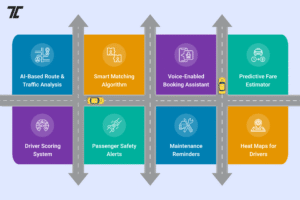
- AI-Based Route & Traffic Analysis
Leverage real-time traffic data and historical movement patterns to dynamically reroute drivers, helping taxi businesses as well as the passengers avoid congestion, roadblocks, and delays. This not only saves fuel and time but also ensures timely arrivals, increasing customer satisfaction in busy urban centers like London or Manchester.
- Smart Matching Algorithm
AI intelligently matches drivers and passengers based on proximity, traffic conditions, and driver ratings to minimise idle time and cancellations. The system continuously learns from past trips to improve future matches, optimising operational efficiency during both peak and off-peak hours.
- Voice-Enabled Booking Assistant
Taxi apps provide hands-free ride booking through AI-powered voice assistants that understand multiple languages and accents. This feature boosts accessibility for differently-abled users and ensures a seamless user experience for commuters who are on-the-go or multitasking.
- Predictive Fare Estimator
Use AI algorithms trained on historical fare trends, distance, real-time traffic, demand spikes, and weather conditions to calculate fare estimates. This transparency builds trust and allows customers to make informed decisions before confirming a ride.
- Driver Scoring System
Track driving behavior such as sudden braking, speeding, and customer ratings to assign dynamic scores to drivers. This data can be used to reward top performers, provide training where needed, and build a safer, more reliable driver network.
- Passenger Safety Alerts
Monitor trip patterns in real-time and send alerts to users or emergency contacts in case of route deviation, long stops, or suspicious activities. This feature enhances the safety layer, making AI-powered taxi apps a more secure choice for solo travelers and late-night commuters.
- Maintenance Reminders
Predict vehicle wear and tear using AI analysis of mileage, engine performance, and past service records. Automatic reminders for oil changes, brake checks, and tire replacements reduce breakdown risks and ensure a dependable fleet.
- Heat Maps for Drivers
Present visually interactive heat maps highlighting zones with high ride demand, upcoming events, or weather-triggered surges. This helps drivers strategically position themselves for maximum earnings while reducing wait times for passengers.
Step-by-Step Guide to Develop an AI-Integrated Taxi Business App
- Market Research & Requirement Analysis
Study regional mobility trends, understand rider expectations, and analyse competitor offerings. Consider local licensing rules, transportation policies, and data protection regulations such as GDPR in the UK.
- Wireframing and Design
Create user-centric UI/UX designs. Incorporate AI-friendly UI elements such as interactive chatbots, smart maps, and predictive booking panels to streamline user journeys.
- Choosing the Tech Stack
Select robust and scalable technologies for:
– Backend: Node.js, Python – for processing heavy AI workloads.
– Frontend: React Native, Flutter – for cross-platform, responsive design.
– AI/ML: TensorFlow, Scikit-learn, Azure AI – to handle data processing, model training, and predictions.
– Database: MongoDB, PostgreSQL – for managing user data, trip records, and payment history.
- AI Model Development
Collect and clean large datasets for training. Build machine learning models to enable features like ETA prediction, user personalisation, fare optimisation, and intelligent driver allocation.
Test models using real-world data to ensure performance under various UK travel conditions.
- App Development
Implement core features (booking engine, GPS tracking, payment gateway) alongside AI modules. Develop admin panels and driver dashboards for complete control and visibility.
- Security & Compliance
Use end-to-end encryption, secure authentication, and tokenized payment systems. Ensure the app meets UK-specific data privacy standards like GDPR and PCI-DSS for financial transactions.
- Testing & QA
Perform comprehensive testing, including unit testing, AI model validation, cross-platform compatibility checks, and load testing under peak traffic conditions.
- Deployment & Support
Launch your app on the App Store and Play Store with full documentation. Set up AI model monitoring tools for continual learning and improvement. Offer post-launch updates, bug fixes, and AI enhancements based on user feedback.
Don’t let your competitors race ahead! Elevate your taxi service with smart AI integrations.
Talk to our experts at Tecocraft to start your AI journey today. Schedule a free consultation!
Challenges in Developing AI-Integrated Taxi Business Apps
- Data Quality and Availability
AI’s efficiency is directly tied to the quality of the data it processes. Taxi companies often struggle to collect clean, structured, and comprehensive datasets from multiple sources like drivers, users, and traffic systems. Inaccurate or incomplete data can lead to unreliable predictions and poor decision-making.
- Integration Complexity
Integrating AI functionalities into legacy systems or third-party APIs requires custom app development, synchronisation of data streams, and ongoing maintenance. Compatibility issues between traditional software components and modern AI modules can cause delays and performance hiccups.
- Compliance and Ethics
AI must operate within strict legal frameworks like the UK’s GDPR. Ensuring that the app collects, processes, and stores user data ethically and transparently is both a legal and moral obligation. Android and iOS app developers must also prevent bias in AI decisions, especially in areas like driver matching or fare estimates.
- User Trust and Adoption
Not all users are comfortable relying on automated systems for pricing, driver selection, or route planning. Building user trust involves clear explanations of how AI makes decisions, offering manual override options, and consistently delivering accurate and safe services.
- High Initial Costs
While AI can reduce operational costs over time, the upfront investment for talent, tools, infrastructure, and training data can be steep. Small taxi businesses may hesitate to adopt AI-powered taxi apps due to budget constraints unless a clear ROI is demonstrated.
- Continuous Learning and Updates
AI models degrade over time if not updated with fresh data. Both iOS and Android app developers must regularly fine-tune algorithms, retrain models, and monitor performance to ensure the system evolves with changing urban mobility patterns and customer expectations.
Conclusion
AI is undoubtedly steering the future of taxi ecosystems in the UK towards greater efficiency, reliability, and user satisfaction. From optimising operations to redefining customer experience, its capabilities are opening new doors for innovation in the taxi industry. For companies looking to stay competitive, the message is clear: embrace AI, or risk being left behind.
Whether you’re a startup planning to disrupt the market or an established taxi company aiming to modernize your services, the integration of AI is no longer optional—it’s essential.
Tecocraft is here to help you navigate this journey. Let our expert team turn your taxi business into a data-driven, intelligent service with scalable AI-powered solutions.
Ready to build a smarter ai-powered taxi booking app? Let’s innovate together.

Related Blog
Want more insights? Read amazing blogs and stay up-to-date with the industry.

How AI in banking drives smarter service in the UK banks?
The AI in banking is nothing but the modern operations of banking; indeed, the AI is revolutionizing the way customer experience will be delivered-no

21 Common Website Development Mistakes That Catch Even the Most Skilled Developers!
Website builders are often seen as tech wizards, conjuring websites out of thin air with their coding skills. But let’s be real—every developer, no m

How Travel Apps are Addressing the Rise of Solo and Adventure Travel Trends
The travel industry has seen a remarkable shift in recent years, driven by the increasing popularity of solo and adventure travel. As more travellers

Find the Top App Development Partner for Your Next project with Tecocraft
In the dynamic world of technology, finding the right app development partner is crucial to transforming your innovative ideas into successful applic

Gamification in App Design: Techniques to Boost User Retention
In today's highly competitive digital landscape, user retention is paramount to the success of any mobile application. App developers constantly seek